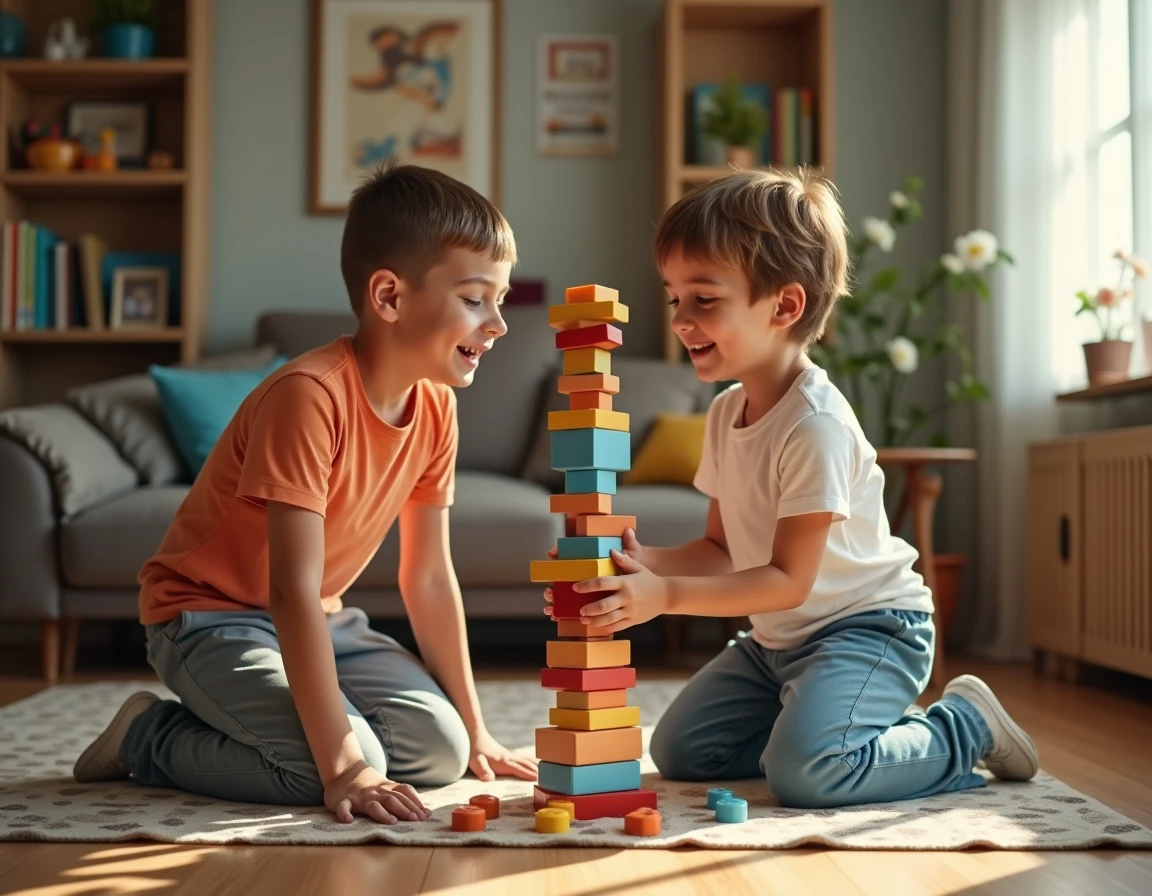
Between a rainy day and a long Wednesday afternoon, finding fun games and activities for children that really hold up requires more than just a simple list of ideas. The question deserves a closer look: not all activities engage the same skills, and their relevance varies according to the child’s age, the available space, and the level of supervision required.
Activities for children categorized by age and skill type
Most guides indiscriminately mix suggestions aimed at toddlers and those for eight-year-olds. The table below groups the main categories of games based on age range and the primary skill involved.
| Type of activity | Age range | Main skill | Space required |
|---|---|---|---|
| Stacking and fitting games | 1-3 years | Fine motor skills | Very limited |
| Modeling clay, gluing, cutting | 3-6 years | Creativity, coordination | Table and chair |
| Motor skills course (cushions, hoops) | 3-7 years | Gross motor skills, balance | Clear living room or garden |
| Board games with simple rules | 4-8 years | Logic, patience, sociability | Very limited |
| Free construction (cardboard, wood, Lego) | 5-10 years | Spatial reasoning | Floor or large table |
| Writing games, small bucket, hangman | 6-12 years | Language, vocabulary | Paper and pen |
This breakdown highlights a point that generic lists overlook: the available space conditions the choice as much as the age. A motor skills course in a thirty-square-meter studio is nothing like the same course in a garden.
Fine motor activities (modeling clay, fitting, gluing) remain the easiest to set up regardless of the housing situation. They require neither complex storage nor constant supervision for children from three years old.
Games in small spaces: adapting the activity to the housing
The most widely shared content on this topic assumes a spacious living room or accessible garden. For families in apartments, spatial constraints radically change the game. Adapting a game to the existing furniture is often more effective than trying to replicate a course designed for a gym.
Some concrete principles work in a reduced space, including a hallway or a shared bedroom. Specialized resources like Poupala offer play materials designed for young children, making daily adaptation easier.
- Use tape on the floor to draw balance lines, hopscotch, or circuits: this transforms a hallway into a course without moving any furniture.
- Replace obstacle courses with vertical games (cardboard target fixed to the wall, throwing socks into an elevated basket) that do not take up floor space.
- Favor role-playing and imaginative games, which only require a corner of the room: a sheet over two chairs is enough to create a campsite, a store counter, or a fort.
Vertical and floor games compensate for the lack of square meters without sacrificing physical activity. Throwing socks engages hand-eye coordination and balance just as much as an outdoor ball game.
Motor activities for children at home: moving without breaking everything
The majority of guides dedicated to indoor activities focus on crafts, drawing, or cooking. The need for movement among children, however, remains under-addressed. A child aged four to seven needs active periods spread throughout the day, not just seated activities.
Alternating a calm activity with a motor activity every thirty to forty-five minutes helps maintain attention without causing overstimulation. The reverse pattern (a long static period followed by a release of energy) often generates more chaos than enjoyment.
Three formats of active games work indoors without specific equipment:
- The musical “stop and go”: the child dances or moves freely, then freezes as soon as the music stops. This format works on impulse control and listening.
- Animal yoga: each pose imitates an animal (cat, downward dog, flamingo). This combines stretching, balance, and imagination, even in a restricted space.
- Modified relay race: instead of running, the child carries an object while walking as fast as possible without dropping it (spoon and ping pong ball, cup of water). The challenge replaces speed with concentration.
These formats share a common trait: they channel energy through the rules of the game, not through the size of the space.
Child development through play: what each age group really gains
Talking about “fun and educational activities” is not enough if we do not specify what the child concretely gains at their stage of development. Toddlers (under three years) derive most of their learning from sensory play: manipulating dough, stacking objects, pouring water from one container to another.
Between three and six years, symbolic play (imitation, dressing up, invented scenarios) structures language and social understanding. A child who “pretends” to be a doctor or a shopkeeper integrates social codes, specialized vocabulary, and the concept of turn-taking.
From the age of six, rule-based games (board games, card games, small bucket) become relevant. They impose the management of frustration, respect for a framework, and strategy. Offering a complex board game to a four-year-old rarely results in anything other than frustration, not due to a lack of intelligence, but because the ability to integrate multiple rules simultaneously is not yet in place.
Adapting the activity to the stage of development avoids frustration for the child and disappointment for the parent. The table in the first section can serve as a quick reference before starting an activity. The most reliable criterion remains observation: if the child loses interest after two minutes, the activity is likely poorly calibrated for their age or the space they have.