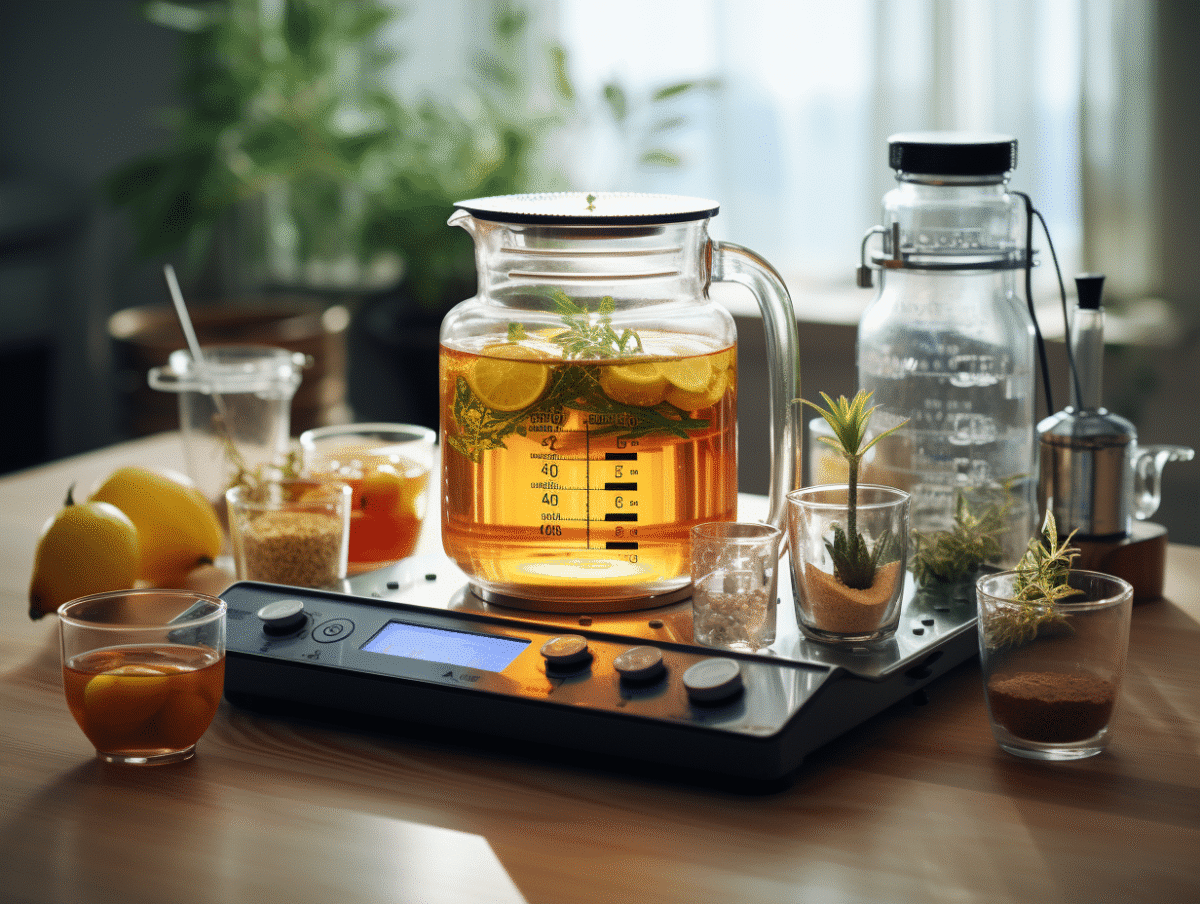
When diving into the delights of cooking, juggling the different units of measurement can prove complex. Precision is key, especially in baking where each ingredient must be weighed to the exact gram. Yet, recipes fluctuate between milliliters, centiliters, and grams, sometimes creating confusion. Understanding the conversion between these units is fundamental to maintaining proportions and successfully executing dishes. The transition from centiliters to grams, in particular, can be perplexing as it depends on the density of the liquid being measured. This is an essential skill that every cooking enthusiast must master.
The relationship between volume and mass: understanding conversions in cooking
Density, this physical property often overlooked outside of scientific laboratories, is nonetheless crucial in cooking, especially when it comes to converting centiliters to grams. A centiliter, which corresponds to one hundredth of a liter, must be converted based on the specific gravity of the liquid being measured. Density, which is the ratio of the mass of a substance to its volume, allows for this conversion. Knowing the density of liquid ingredients becomes essential for any precise conversion.
Common liquids do not have the same density. Water, for example, often serves as a reference with a density of about 1 g/cm³, which simplifies the conversion: 20 cl to grams for water translates directly to 200 grams. In contrast, other liquids like olive oil, which has a density around 0.92 g/cm³, require an adjusted approach. For it, converting 20 cl to grams will require multiplying the centiliters by the specific density, resulting in approximately 184 grams.
This conversion principle is not fixed and can vary depending on temperature and pressure, factors that slightly alter the density of substances. In the context of home cooking, these variations are generally so minimal that they can be ignored. For the meticulous cook, however, it is wise to keep these subtle fluctuations in mind.
As precision is a cornerstone of gastronomy, having graduated kitchen utensils and a kitchen scale is undeniably practical. For common conversions, conversion charts exist and are easily accessible. They provide basic equivalences for a multitude of ingredients, allowing the cook to focus on the art of preparation rather than on mathematics. However, in the absence of these aids, the conversion formula remains simple: mass (in grams) = volume (in centiliters) × density (in g/cm³). This is the recipe for a successful conversion, ensuring the accuracy of each measurement.

Practical guide for converting centiliters to grams
Know your tools: before diving into the heart of the matter, ensure you have a good quality kitchen scale. It should be capable of measuring small quantities accurately. Graduated kitchen utensils such as measuring cups and spoons complete the arsenal for reliable volume measurements. Their use, coupled with a scale, guarantees an exact conversion from centiliters to grams.
Conversion charts, these valuable directories that compile basic equivalences, prove to be a great help. They allow for quick conversion of volumes to weights for the most common liquids, without the need for calculations. Keep these charts handy to consult the density of the ingredients used and proceed with the necessary conversions confidently.
Using the conversion formula: when you do not have access to a conversion chart or for liquids with less common densities, the conversion formula takes over. Mass (in grams) = Volume (in centiliters) × Density (in g/cm³). This simple equation allows you to transition from centiliters to grams by simply multiplying the volume of the liquid by its specific density.
Online conversion tools, often overlooked, are nonetheless a modern and practical resource. Many websites and applications offer automatic converters that perform the calculation instantly. Don’t forget to input the correct density to obtain a reliable result. These digital tools cater to those seeking speed and convenience in their liquid measurement conversions in cooking.