How to start my vegetable garden naturally on a grassy area?
This is a question that every beginner gardener asks!
Many times, they have already learned a lot about crops.
But when it comes time to start, they feel a bit lost and many questions arise:
- Where should I begin?
- How do I get rid of the weeds?
- Should I till the soil when today I’m advised not to?
- But if I don’t till it, how will I plant my seedlings?
In short, these are many questions that we will try to answer today by presenting several possible techniques (non-exhaustive list).
Whatever method you choose, I recommend to start by cutting the grass as low as possible. Then let it start to break down before beginning the work.
Mulching
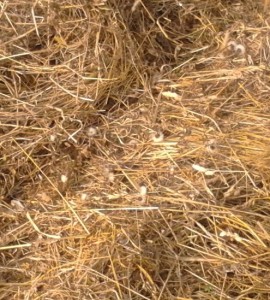
Mulching allows you to start a vegetable garden naturally. The goal is to smother the spontaneous vegetation and thus prevent its development the following spring.
If possible, at the end of summer or the beginning of autumn (when the soil is still relatively warm), apply a thick layer (at least 10 cm on light soil — up to 5 cm on heavy soil) of straw, old hay, cut grass, wood chips, or other plant materials.
Then, all you have to do is remove the mulch the following spring to sow or plant.
Be careful: this technique can be problematic on heavy soils (risk of suffocation) or when used at the wrong time (dry or cold soil).
Working the soil
This solution can be usefully considered, especially if the soil of our future garden turns out to be particularly clayey or compacted…
In heavy soils, work the soil in the autumn.
In sandy soils, with little or no clay, it is better to wait until spring to start working the soil.
If possible, work with a broadfork; this now-famous tool allows you to loosen the soil without turning it over. With the broadfork, we always work from underneath, using its weight to push the tool. So, we simply make a small rotational movement to loosen the soil.
Work for the first time, without pushing the tool too hard, just eradicate the weeds, then let them dry or remove them to put them in the compost (it’s better if the weather is rainy, otherwise the weeds might regrow).
Work again perpendicular to the first pass, but this time pushing the tines all the way in. Then, add the compost and incorporate it with a new pass, which should normally allow for a sufficient slow loosening of the soil.
For a larger area, although not compatible with a natural garden, it might be necessary to work with a producer (preferably with a producer rather than a rotary tool, also to avoid turning the soil) or with a rotary machine (but then you might multiply the roots of unwanted grass).
Several spaced steps in time will allow you to properly loosen the soil and rid it of a large part of the spontaneous vegetation.
An effective solution: tarp!
I will now talk to you about a solution that, while not satisfying the most eco-conscious among you, remains an effective common practice.
This method simply involves laying a black tarp over the area you want to cultivate. Secure the edges well so it doesn’t blow away. Leave the tarp until all the weeds disappear underneath (this will take 2 to 6 months depending on the season and weather conditions).
The result is perfect for starting new crops: soft and warmed soil without unwanted weeds, teeming with life.
- You want to sow: spread the compost and then loosen the soil with a broadfork or a rake.
- You want to plant: dig your planting hole and incorporate mature compost.
Then mulch (this time with plant-based materials).
The tarp can then be reused for a melon crop, for example (a good way to achieve this delicate crop).
Building a crop mound (lasagna).
For planting, lasagna beds can be prepared in spring, just before planting.
For sowing, I think it is better to prepare the mound in the previous autumn.
- Place the boxes on the ground, crossing them over each other.
- Then cover them with caps;
- Next, add wood chips during decomposition;
- Cover with a thin layer of green materials (freshly cut grass, garden waste, crushed young deciduous twigs);
- Add rotting (fall) or mature (spring) compost.
You will thus have a growing mound that is particularly rich in nutrients.
Do you want to start a natural garden?
I can help you make choices suited to your growing conditions…
Start in the best state by taking advantage of my offer including My Natural Vegetable Garden and 1 year of decoding.
Tag: make a vegetable garden on a lawn