
Starting a real estate investment in France when you are an expatriate is never easy. The distance, time zone differences, being far from the French atmosphere, and lack of market knowledge are all factors that complicate decision-making. However, real estate remains one of the most attractive long-term investments for several reasons, especially when you are an expatriate. We present to you the reasons why we believe you should not wait to invest in rental real estate.
Real estate in France, a profitable investment
A dynamic French market
In its latest study, Meilleur taux compared the profitability of 7 different investments: real estate, livret A, stocks, government bonds, money market funds, life insurance, and gold. And guess what? Real estate investment is the best performer over 20 years.
Indeed, the volatility of a real estate investment is very low and its profitability remains high, particularly due to the leverage effect of credit. Rental investment is therefore a safe and profitable bet. It would even be a shame not to take advantage of it during your expatriation since you can now buy a studio or a two-room apartment in Paris, Lyon, Bordeaux, or Marseille with as little as 20% of the apartment’s value, or even 10% under certain conditions.
Moreover, the French real estate market is particularly dynamic today. 2019 had already broken all records, and 2020 is also very dynamic. In January 2020, the prices of older properties increased in many cities. Paris (where the price per square meter has exceeded €10,000) and Lyon (where housing prices rose by 7.7% in 2019), along with Bordeaux, remain the most expensive cities in France in terms of real estate. In 2019, the average price per square meter in the older market increased by 4.7%. It rose by 3.5% in 2018.
If you are an expatriate, then the time is ideal to start a real estate project or to reconsider your real estate project if you had set it aside. Additionally, My expat offers solutions to organize everything for you, and to successfully carry out your real estate project without ever having to return to France.
Strong demand in major cities You might be interested in this article: Real estate investment, the 5 pitfalls to avoid
If you want to invest in France, it is recommended to focus on major cities. Indeed, they attract many investors due to their dynamism, attractiveness, growth, real estate prices, and investment profitability. Paris, Bordeaux, Lyon, and Marseille attract many professionals and students. The demand in these cities is therefore very high. This leads to low rental vacancy rates and secures the investment made.
In Paris, the average price per square meter is around €10,175 for an apartment at the end of January 2020.
A 20m2 apartment in the capital therefore requires an average budget of €203,500. The rents collected for this type of property amount to about €650 per month. However, there is a significant difference between the various districts.
In Bordeaux, the average investment required to purchase a 20m2 apartment is around €90,100 (the average price per square meter in January 2020 is €4,505 for an apartment). And in the context of an investment rental, the average monthly rent would be €300.
As for the City of Light, Lyon, its prices are close to those of Bordeaux. Indeed, the selling price for this area is on average €91,700. Rents are also aligned with those of Bordeaux.
Finally, in Marseille, you will need to budget €51,940 for the purchase of an apartment of the same size (€2,597 per square meter). As for the rent, it amounts to €260 per month for this type of property (€13 per square meter).
Old real estate, an interesting tax
If you are an expatriate and wish to invest in France for rental purposes, it is advisable to opt for an older property.
New properties do not offer tax advantages to non-residents. Now, with older real estate, you will be able to benefit from property tax deficits, as well as the status of Non-Professional Furnished Rental. The LMNP system allows you to receive rental income that is not taxed and to deduct management fees, interest on your mortgage, and renovation costs, under certain conditions. To be eligible for the LMNP status, the property must be furnished. The income generated from the rental must not exceed a certain amount. It is €23,000 per year, which is 50% of the total income of the owner.
Additionally, compared to new properties, older real estate will be more economical (a new property costs, on average, 20-30% more than an old one); profitable (the new could lead to the owner’s loss of 18 to 24 months of rent, and the gross annual yield is between 2 and 5% for older properties, compared to 2-4% for new properties). The demand for rentals is also higher because older properties are often located in lively neighborhoods, in the center. On the other hand, new properties are generally located on the outskirts. Furthermore, even though renovating an older property may sometimes discourage some investors, it will reduce the risk of malfunctions or long-term problems and increase the asset’s value.
Historically low rates conducive to investment You can also read: All the benefits of Non-Professional Furnished Rental
Investing in real estate in France also ensures that you benefit from particularly attractive mortgage rates. In 2019, borrowing rates were historically low.
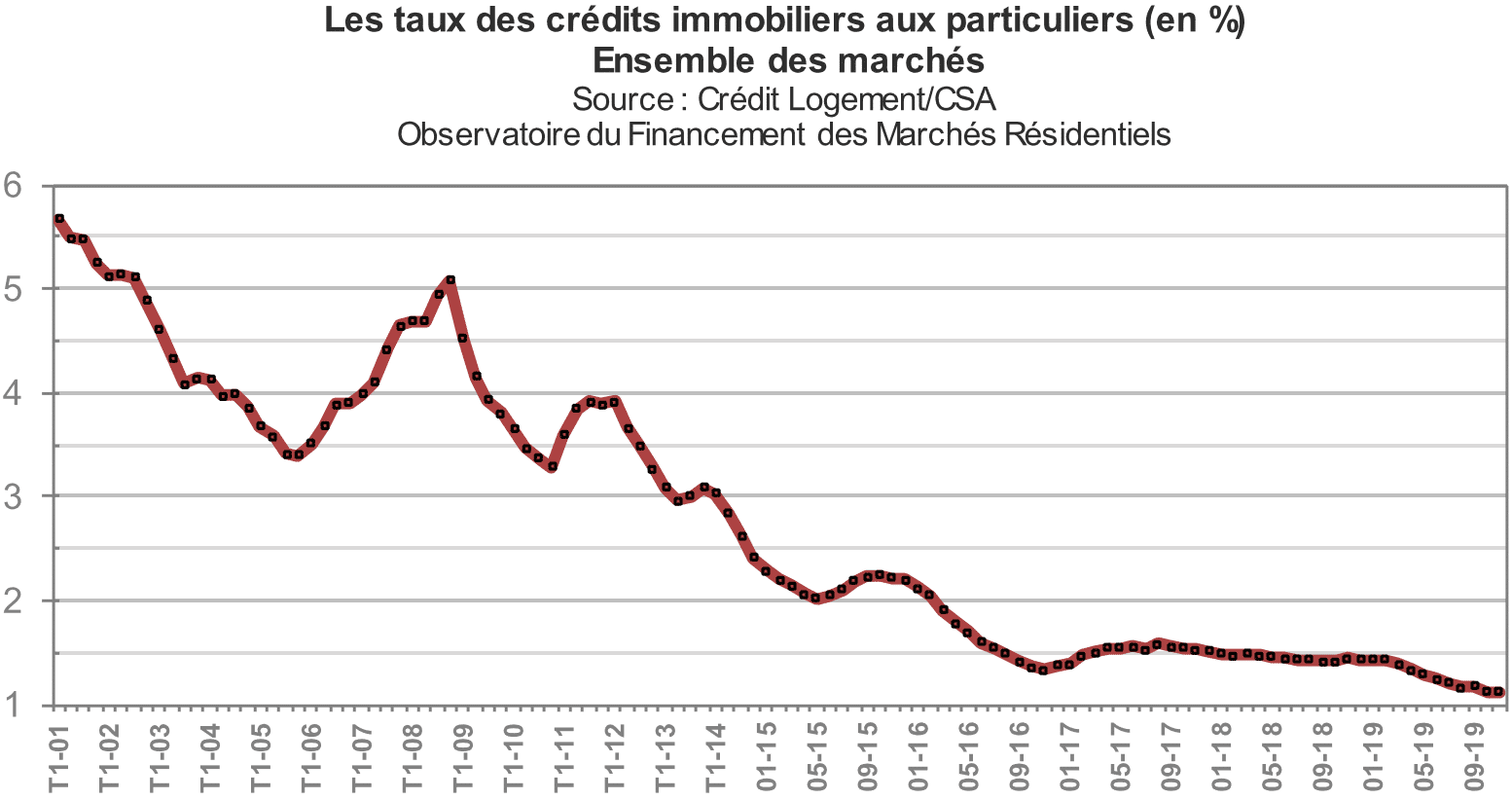
source: l’Observatoire du crédit immobilier — September 2019
Although rates for non-residents or expatriates are slightly higher than those offered for French residents (a non-resident represents a greater risk for the bank of not being repaid), it is now possible to borrow at an average rate of 1.26% over 20 years. The time is therefore ideal for borrowing. Moreover, there are banks that adapt very well to expatriates and grant them loans for their real estate projects (such as Crédit Agricole, BNP Paribas, or Le Crédit Lyonnais).
In the same vein: discover the rates offered to non-residents According to Best Rate, in January 2020, borrowing rates were on average 1.10% for a 15-year loan, 1.26% for 20 years, and 1.49% for a 25-year loan.
In the coming months, average rates over 20 years are expected to remain stable (between 1.30% and 1.50%). Spectacular decreases like those in 2019 should not be expected.
Preparing your tax declaration and/or your retirement You might also read: Which banks lend to non-residents?
Your return to France or that of your children
One of the main reasons why French expatriates invest in France is the anticipation of their return to France. Many expatriate investors choose to invest in a residence to anticipate their return from expatriation, or in a studio or two-bedroom apartment to prepare for their children’s return to France for their studies. This allows them to have a foothold during their short stays in France.
Real estate remains a very good physical investment, of which you are certain of its utility: to live in or to rent (unlike SCPI, for example, which constitutes a pure financial investment).
Investing for your retirement
Investing in real estate is undoubtedly one of the best ways to prepare for retirement when you are an expatriate. Indeed, the risk is low and the long-term return is high. This makes it an ideal investment for an expatriate who wants to anticipate retirement in 15 or 20 years. Additionally, the longer the loan duration, the smaller the monthly payments will be. Good planning is therefore essential.
Furthermore, real estate investments in France will be particularly reliable and ensure high profitability, provided they are invested in cities with high population density, where rental demand is high.
You might also read: Expatriate on a local contract, how to prepare for retirement? Finally, bank borrowing rates are very low at the beginning of 2020 and are expected to remain generally stable and favorable. As you approach retirement, if you invest early enough, your loan will be repaid and your rental income will improve your purchasing power and quality of life.

Tag: tax benefits with real estate